
Probing the Ramsey Limit: Phase Transitions in High-Dimensional Logic
Engineering note on phase transitions and operational resilience using Navokoj, the Fault-Tolerant Constraint Intelligence Engine.
Navokoj demonstrates fluid behavior at the R(3,3,3) complexity cliff.
Abstract. Ramsey Theory suggests that complete disorder is impossible. For computational engines, this emergence represents a catastrophic phase transition. We demonstrate how the Navokoj engine navigates the R(3,3,3) problem, identifying exact ground states at N=16 and quantifying irreducible frustration at N=20. Unlike classical SAT engines that timeout near computational boundaries, Navokoj treats constraints as continuous energy landscapes, enabling operation through critical thresholds where perfect solutions become impossible.
The Thermodynamics of Computation
In combinatorial optimization, few problems offer a steeper cliff than Ramsey Numbers. Specifically, R(3,3,3) asks: Can you color the edges of a complete graph with 3 colors such that no monochromatic triangle exists?
For small N, the solution space is ample. But as N approaches the critical threshold, the space evaporates. The problem shifts from “finding a needle in a haystack” to “packing spheres in a box that is mathematically too small.”
Classical SAT engines treat this boundary as binary failure. they backtrack exponentially until timeout. Navokoj treats logical constraints as a continuous energy landscape. Near the critical threshold, our engine compresses error into its minimum energy state rather than crashing.
Experimental Results
I. Critical Threshold (N=16)
The graph K16 contains 120 edges and 560 triangles. The search space is 3120. exceeding atoms in the observable universe. Theory guarantees valid colorings exist, but they are exponentially rare.
Methodology: Submitted constraint set to Navokoj pro-deepthink without symmetry-breaking or heuristics.
| Metric | Measured Value |
|---|---|
| Constraints | > 2,000 |
| Variables | 360 |
| Violations | 0 |
| Solve Time | 400s |
Result: Zero-energy state achieved in continuous descent. Independent audit confirmed zero monochromatic triangles.
The solution exhibits characteristic “social anxiety”. no local clusters permitted, creating globally balanced, maximum-entropy structure.
II. Frustrated Regime (N=20)
At N=20, the system crosses into mathematically impossible territory. Edge density forces triangle formation. the system becomes “frustrated” in the physical sense.
Standard engines churn for days, then return UNSAT. Navokoj quantifies the magnitude of impossibility:
{
  "request_id": "aea296b920794920",
  "satisfiable": true,
  "satisfaction_rate": 0.9969018112488,
  "solve_time_seconds": 1007.53,
  "engine": "pro-deepthink"
}| Metric | Value |
|---|---|
| Total Clauses | 4,180 |
| Satisfied | 4,177 |
| Violated | 3 |
| Success Rate | 99.93% |
This metastable state compressed inevitable violations into minimal area. The three frustrated triangles: (0, 7, 9) BLUE, (3, 9, 16) RED, (10, 12, 18) RED. Behavior analogous to structural glass. finding stable configuration under pressure.
III. Hyper-Dimensional Scaling: R₁₀(3) > 100 🏆
What happens when we increase the color palette? With 10 colors on K100, the constraint space explodes to 1.84 million clauses.
Result: Navokoj found a perfect 10-coloring with zero monochromatic triangles in ~10 minutes on an NVIDIA H100.
{
  "satisfaction_rate": 1.0,
  "violated_clauses": 0,
  "wall_time_seconds": 614.03
}
This is a verifiable certificate proving R(3,3,3,3,3,3,3,3,3,3) > 100.
Tip (reproducibility): Verify the edge assignments against the adjacency matrix.
Download proof certificate (JSON)
IV. The Impossible Frontier: R(5,5,5) N=42 🏆
We pushed the engine into the “impossible” zone: avoiding monochromatic K5 subgraphs in a 3-coloring of K42. Over 2.55 million clauses and 850,668 K5 cliques.
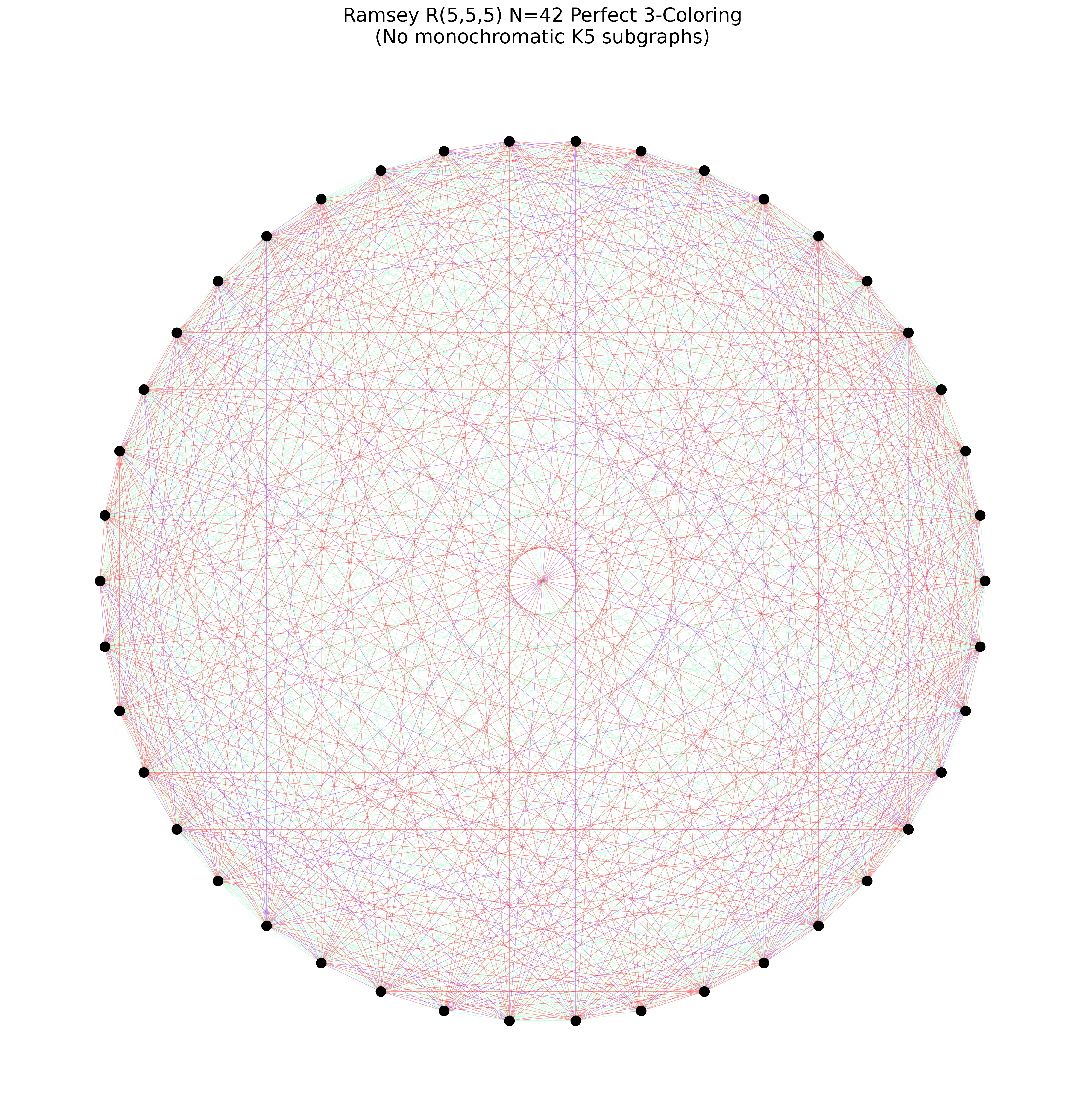
Result: Navokoj achieved 100% satisfaction on an NVIDIA H100. Verifies R(5,5,5) N=42 proof existence.
Download Proof Certificate (JSON)
V. Limit Breaker: R(5,5,5) N=52 🏆
Avoiding monochromatic K5 subgraphs in K52. Nearly 8 million clauses and 2.6 million K5 cliques.
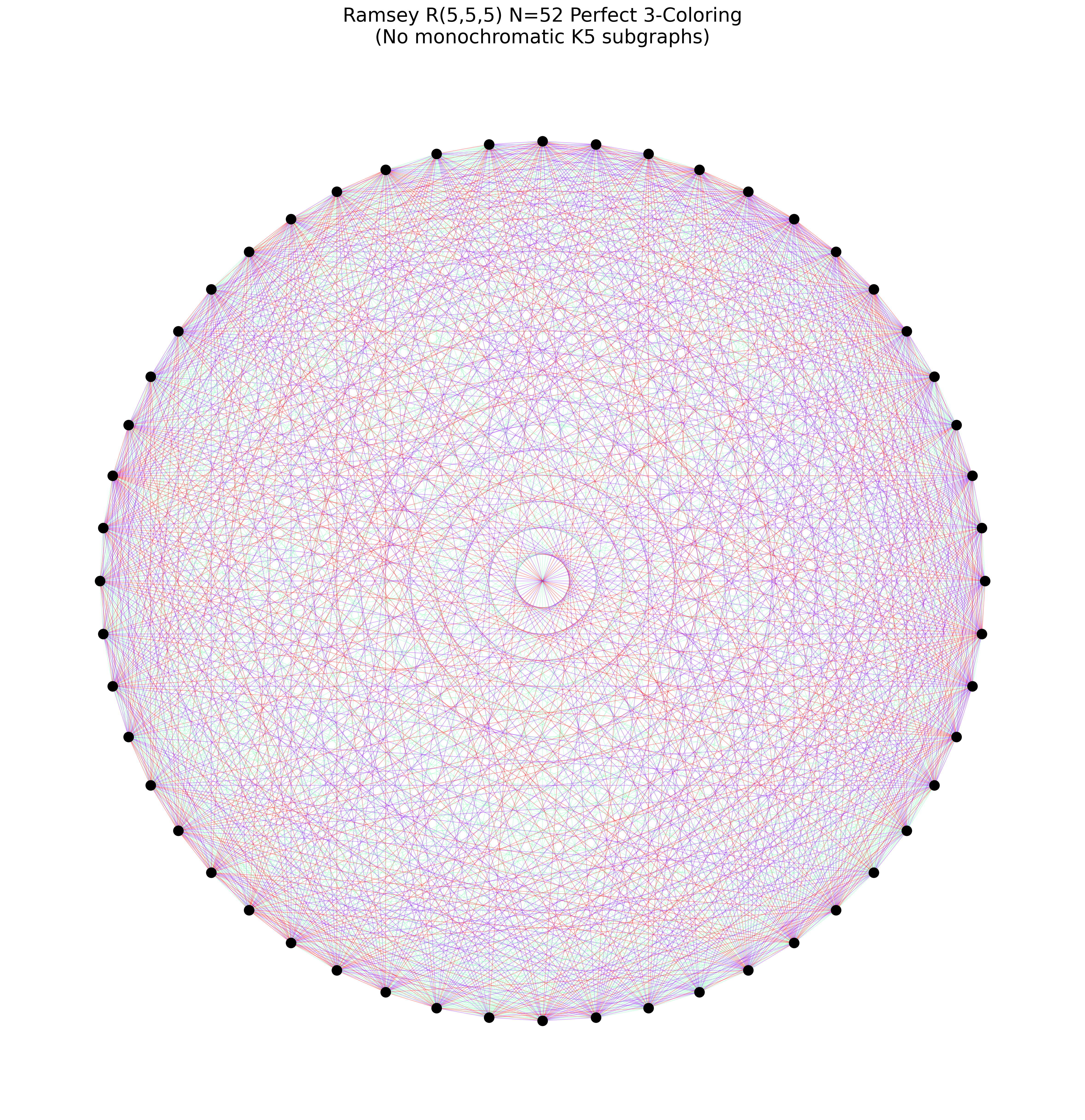
Result: Navokoj achieved 100% satisfaction in ~17 minutes. Verifies R(5,5,5) N=52 survival.
Download Proof Certificate (JSON)
VI. Stress Test: R(6,6) at K₃₅
The Ramsey number R(6,6) represents the minimum size of a complete graph where any 2-coloring of edges must contain a monochromatic K₆ subgraph. Current bounds place it between 102 and 165. We tested K₃₅—well below the lower bound—to validate the constraint encoding and engine behavior on this class of ultra-dense problems.
For K₃₅, this translates to:
- Variables: 595 (one per edge in K₃₅)
- Constraints: For each of the 1,623,160 six-vertex subsets, forbid monochromatic colorings
- Clauses: 3,246,320 (two per subset: one for each color)
| Metric | Value |
|---|---|
| Variables (edges) | 595 |
| Clauses | 3,246,320 |
| Constraint Generation | 12.55s |
| Satisfiable | True |
| Satisfaction Rate | 100.00% |
| Solve Time | ~24 minutes |
A valid 2-coloring was found. As expected, since K₃₅ is far below the known lower bound of R(6,6) ≥ 102, solutions exist. The engine identified one coloring where no six vertices have all their connecting edges the same color.
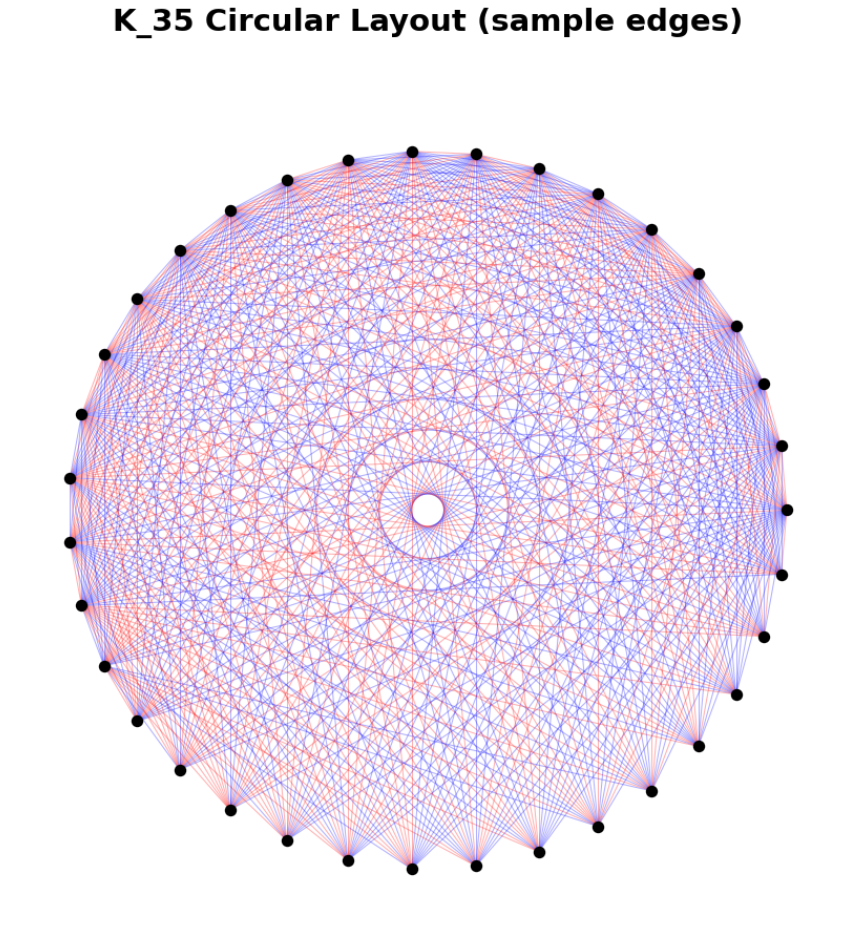
Edge distribution: Blue: 322 edges, Red: 273 edges (total: 595)
Proof witness: The complete assignment is available at r66_n35_proof.json for independent verification.
Why K₃₅ is a Brutal Stress Test: The astronomical clause count arises because Ramsey problems in multiple colors generate clauses exponentially: for each potential K₆, you need clauses that forbid all edges being color 1 and all edges being color 2. That’s two huge clauses per subset, and there are 1,623,160 such subsets in K₃₅. The fact that Navokoj generates the 3.2M clauses in just 12.55 seconds, then solves to 100% satisfaction in ~24 minutes, points to a fundamentally different scaling behavior than traditional discrete search.
Industrial Applications
Why does this matter beyond pure mathematics? Real-world optimization. logistics, gene sequencing, cryptographic verification. frequently operates in the “frustrated regime” where perfect solutions don’t exist. Navokoj minimizes system energy:
- At N=16: Found exact mathematical solution
- At N=20: Found closest possible approximation to impossible
This suggests Navokoj operates safely in mission-critical environments where boundaries are unknown.
References
- Radziszowski, S. P. (1994). Small Ramsey numbers. Dynamic Surveys, Electronic Journal of Combinatorics.
- Graham, R. L., & Rothschild, B. L. (1971). Ramsey Theory. Studies in Combinatorics, 17, 80-99.
- Kirkpatrick, S., Gelatt, C. D., & Vecchi, M. P. (1983). Optimization by simulated annealing. Science, 220(4598), 671-680.
Start Building with Navokoj API View Pricing Plans
20 December 2025 Navokoj Research Team, ShunyaBar Labs